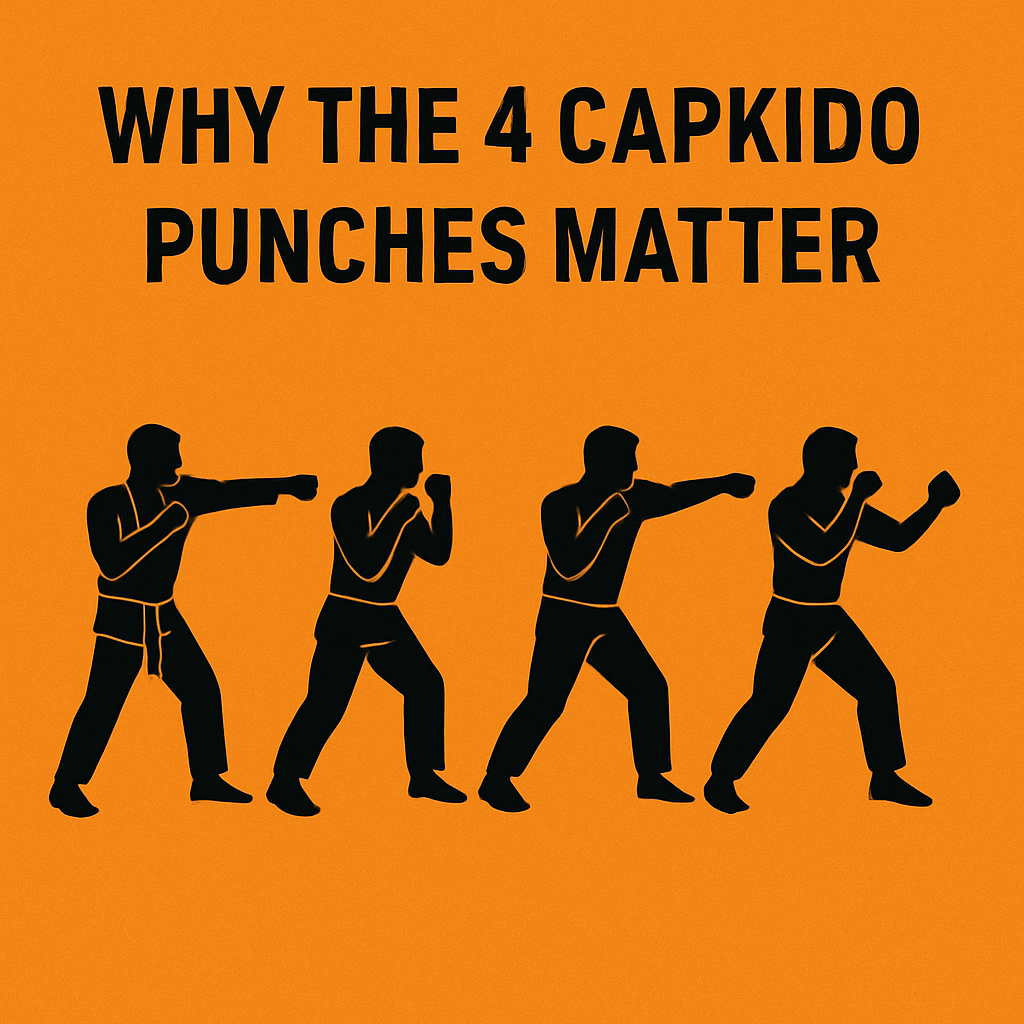
Why the Four Capkido Punches Matter
Every martial artist begins with simple movements—a punch, a step, a block. But there comes a point where technique must evolve into instinct. This lesson marks that transition inside the Capkido system. By connecting the four foundational punches with the right footwork, timing, and mindset, you begin to build self-defense that works under real pressure.
The Foundation of Forward Pressure and Real-World Application
Capkido is built on simplicity, efficiency, and adaptability. The four punches you’ve drilled over and over are not meant to exist in isolation. They create the engine behind your forward pressure, defensive structure, and angle-based entry. Each punch is effective alone, but their true value appears when they are linked into a continuous, flowing sequence. This lesson shows you exactly how to “connect the dots” and turn single movements into a functional chain.
Muscle Memory—The Real Key to Instinctive Self-Defense
Before reaching this level, the expectation is high repetition. Whether you trained 500, 5,000, or 50,000 times, the purpose is identical: developing muscle memory strong enough to free your mind during a confrontation. Once your body can execute these punches without conscious thought, you gain the ability to evaluate distance, timing, and threats while still striking effectively.
The Elbow–Foot Connection That Controls Your Balance and Power
A central principle of this lesson is the relationship between the elbow and the corresponding foot. Each time an elbow chambers or strikes, the connected leg advances. This unites the upper and lower body into one coordinated action. When done properly, the movement feels smooth, balanced, and direct. When repeated endlessly, it becomes instinct—something your body activates naturally under stress.
Training From Both Stances for True Adaptability
One of the biggest limitations beginners face is relying on a single stance. Capkido eliminates this weakness. To be effective in unpredictable situations, you must perform the four punches from both right-foot-forward and left-foot-forward positions. Only when neither stance feels strange do you gain the freedom to move, shift, and attack from any angle without hesitation.
The Mindset Shift—When to Walk Away and When to Commit
Technique alone is not enough. Real-world self-defense demands the correct mindset. This is where the analogy of Dr. Jekyll and Mr. Hyde comes in. Sometimes you walk away. But if walking away is impossible, you must activate your inner protector fully and without hesitation. Once you commit, the objective is simple: go through, around, under, or over your opponent—whatever ends the threat and keeps you safe.
Seeing the Four Punches in Motion Through Partner Demonstration
The lesson concludes with a mock battle demonstration. This shows how the punches flow once the fundamentals are in place: stable footwork, clean angles, and continuous forward pressure. What once felt like isolated techniques now resemble functional, instinctive self-defense. Whether used in a simple form or expanded into more sophisticated layers, the effectiveness comes from clarity and repetition.
Building a Reliable Core for All Future Capkido Training
Capkido is not choreography—it is functional movement built for unpredictable situations. These four punches, combined with correct footwork, stance switching, and the right mindset, create a foundation you will use throughout your entire martial-arts journey. Master them and advanced techniques become easier to learn and apply. Neglect them and everything else becomes more difficult.
The goal never changes: instinct, balance, forward pressure, and safety. Connect the dots, practice until the movements feel natural, and trust the training process that has shaped generations of martial artists.
Get the Dynamic Iron Punch
To take the next step in your Capkido training, you need the strike that gives every movement stopping power.
Get the Dynamic Iron Punch and learn the exact mechanics that turn a basic punch into a fight-ending technique.